

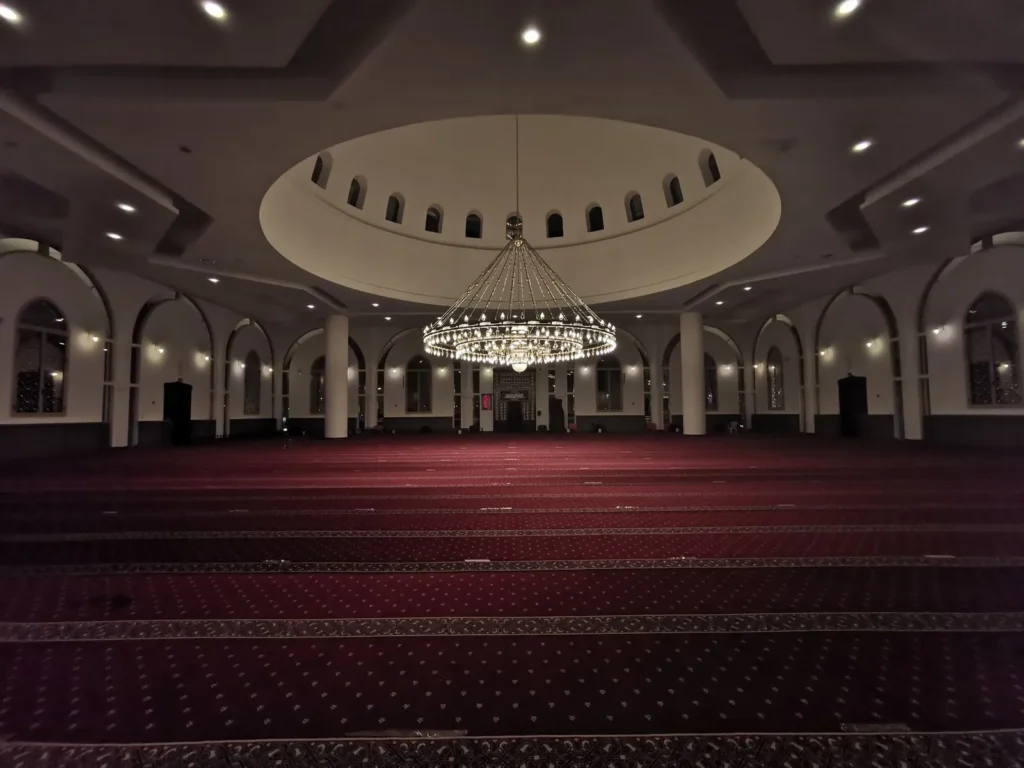
Changing into Ihram at Jeddah airport is possible for pilgrims who arrive in ordinary clothes and want to be in the state of Ihram before their taxi to Makkah, but it depends on knowing where the washrooms and prayer rooms are, keeping your Ihram garments in your hand luggage, and telling your driver that you need a little time after you clear customs. King Abdulaziz International Airport lists 40 prayer rooms across its terminals on its official site, which gives you somewhere clean to pray the two rak’ahs many pilgrims offer before making their intention. What the airport does not advertise is a dedicated Ihram changing facility, so the practical plan below assumes you will use standard washrooms and prayer spaces rather than a purpose-built room.
Is Jeddah airport inside or outside the Miqat?
This is the first question most UK pilgrims ask, and it is not one a transport company should answer. Whether a traveller arriving by air at Jeddah may delay entering Ihram until the airport, or must be in Ihram before the aircraft passes the Miqat boundary, is a matter on which qualified scholars have expressed different views over many years. Some UK pilgrims follow guidance to put on Ihram before boarding or during the flight; others are advised by their scholars or Umrah group that Jeddah is an acceptable place to assume Ihram.
Ask the scholar you normally consult, or the religious guide attached to your Umrah group, before you fly, and follow that advice. For reference, the Ministry of Hajj and Umrah’s English Umrah guide, as published in October 2026, says that pilgrims make Ihram from the nearest local Miqat in the direction they came from, and that if an aircraft’s path passes two Miqats, Ihram is made from the nearest one. That is the official wording; how it applies to your particular routing is a question for your scholar, not for us. This article only deals with the logistics of each choice: where you can wash and change, how it fits with baggage and immigration, and what to tell your driver. Our earlier guide on Miqat and Ihram transport planning covers the broader journey; this one concentrates on the airport itself.
Changing into Ihram at Jeddah airport: where to wash and change
Jeddah has more than one terminal and airline allocations change, so rely on your airline and your confirmed transport booking for the terminal you will use rather than on memory from a previous trip. The airport’s official website describes 40 dedicated prayer rooms across its terminals, together with free Wi-Fi, baggage wrapping and wheelchair assistance arranged through your airline. It does not list shower facilities or Ihram changing rooms, and we could not verify any such service on an official page, so do not plan around one existing. In other words, the Ihram facilities Jeddah airport offers, going by its official listing, are prayer rooms and ordinary washrooms rather than anything purpose-built for pilgrims.
In practice, pilgrims who change at the airport use the washrooms in the arrivals hall or near the prayer rooms. Washrooms in a busy international terminal are functional rather than spacious, so changing is quicker if your Ihram is already folded at the top of your hand luggage with the belt or safety pins you intend to use. Men changing into the two unstitched sheets usually find a cubicle easier than an open area; women, whose Ihram clothing is ordinary modest dress, often only need to remove scent and adjust what they are wearing. Look for signage to the prayer rooms as soon as you leave baggage reclaim and ask airport staff if you cannot see it.
Before you land: what to pack in your hand luggage
The most common mistake is packing Ihram in the hold. Checked bags can be delayed, and even when they arrive promptly you will be unpacking a suitcase on the floor of a crowded hall. Keep in your cabin bag: the Ihram garments themselves, a belt or money pouch without stitching if that is your practice, unscented soap or wipes, a small towel, a plastic bag for the clothes you take off, and footwear that complies with the guidance you follow. Our article on Umrah baggage allowance and hand luggage lists what else belongs in the cabin bag.
Make the ghusl or wudu you intend to make before you leave the UK or during a stopover if you can, because it is far easier at home than in an airport washroom. Trimming nails and removing unwanted hair are also best done before departure for the same reason. Keep the garments in a clear bag so security screening does not require you to unpack them.
Changing before boarding, on the plane, or at the airport: the trade-offs
If your scholar advises entering Ihram before the Miqat, you have two realistic options on a direct UK flight: change at your departure airport, or change on board. UK airports have multi-faith prayer rooms and washrooms, and changing before departure means you fly in Ihram, which is comfortable in the cabin for most people but means the whole flight is spent observing the restrictions of Ihram, including not using scented products. Many pilgrims make the intention itself only when the aircraft approaches the Miqat, which some airlines announce.
Changing on board is possible but cramped, and cabin crew may ask you to wait until the service is finished. If you plan to do it, choose a time well before the Miqat announcement rather than at the last minute. Changing at Jeddah airport, where that is the advice you follow, gives you space and time but means arranging the sequence of immigration, baggage and prayer carefully. There is no single best answer; the right one is the one that follows your guidance and that you have rehearsed mentally before the day.
The arrival sequence: immigration, bags, Ihram, driver
Here is a sequence that works for pilgrims changing at Jeddah. First, clear immigration with your passport and, if asked, your Nusuk details and vaccination certificate; UK government advice confirms the meningococcal quadrivalent vaccine requirement for Hajj and Umrah pilgrims. Second, collect your checked bags, because leaving them circulating on the belt while you change is a security problem and the reclaim area is not somewhere to return to easily. Third, pass through customs into the public arrivals hall.
Only then go to the washrooms and prayer room to change and pray. Finally, meet your driver at the agreed point. The reason for this order is that most meeting points for pre-booked drivers are in the public arrivals area, and a driver cannot wait for you airside. If you try to change before collecting bags, you add time at the belt and risk bags being moved aside by staff. Our guide to meeting your driver at Jeddah airport explains how the meeting instructions in a confirmed booking work.
Telling your driver you need time to change
A pre-booked driver plans the pickup around the flight number and arrival time you gave when booking, and expects you to appear in the hall a reasonable time after landing. If you add extra time for washing, changing and praying, the driver needs to know, or they may assume you are lost or have missed the pickup. Tell the booking team at the time you book, in the notes or by email, that you will change into Ihram after customs. Then, once you have your bags and your UK phone has connected to a Saudi network, send a message confirming you are inside and will be out shortly.
Hajj & Umrah Taxi confirms journeys with written meeting instructions because terminal arrangements at Jeddah change, and the same confirmation is where you will find how to contact the driver on the day. Waiting time rules vary between providers, so check what your booking includes before you rely on it. Hajj & Umrah Taxi’s own FAQ lists waiting time among the factors that affect the final quote and says such arrangements should be agreed before booking rather than decided on the day; it also says live flight tracking is not currently promised, which is another reason to send that message yourself.
Check the FCDO advice before you fly to Jeddah
Where you land shapes where you change. As of 13 October 2026, FCDO travel advice warned British nationals against all but essential travel to King Abdulaziz International and every other Saudi airport apart from Prince Mohammad bin Abdulaziz in Madinah, and to Jeddah, Taif and Dammam as cities, so check the current wording and your insurance before buying flights into Jeddah.
Flying into Madinah instead would put a different Miqat on your route and move the changing question to another airport and another day; settle that sequence with your scholar before you travel.
Women pilgrims: what actually changes at the airport
For women, Ihram does not involve special garments, so the airport step is usually about removing perfume, checking that the clothing worn on the flight meets the modesty standards their guidance requires, and making the intention at the appropriate point. Some women prefer to change out of travel clothes into a fresh abaya and headscarf after a long flight, which the washrooms allow for. Women travelling with a group or family will find the prayer rooms a useful place to regroup while others change.
Women travelling alone should expect prayer rooms to be separated by gender, as is usual in Saudi airports, and that the public arrivals hall is busy with families and drivers. Keep your bag with you at all times and agree the meeting point with your driver before you go to change. Our guide for female pilgrims travelling alone goes into transport safety in more detail.
Children, elderly relatives and Ihram at the airport
Families often find the airport is the hardest place to get young children into Ihram, because everyone is tired and the hall is noisy. Whether children need to be in Ihram at all, and from what age, is again a matter for your scholar, but if they are, it is simpler to dress them before the flight or on board where they can be settled, and to use the airport only for adults. Elderly relatives who find airport washrooms difficult may similarly prefer to be in Ihram before landing so that the arrival is just bags and driver.
If anyone in your party uses a wheelchair, airline assistance ends when you reach the arrivals hall, so plan how they will move between the washroom, prayer room and meeting point. Prayer rooms are generally accessible, but check with staff. A private vehicle booked in advance means the car is waiting rather than the family queuing for a taxi in Ihram in the heat.
A fictional pilgrim’s arrival, step by step
Picture a fictional first-time pilgrim from Manchester, travelling alone on a direct flight that lands in the evening. He is not a real customer and this is an illustration. His scholar has advised him that he may assume Ihram at Jeddah, so he flies in ordinary clothes with his two Ihram sheets, a belt, unscented soap and a towel in his cabin bag. He made ghusl at home before leaving.
After landing he clears immigration, collects his suitcase and walks through into the public hall. He has already told his transport provider, in the booking notes, that he will change after customs, and he sends a short message to the driver as soon as his phone connects. He finds the signage to the prayer room, uses a washroom cubicle to change, places his travel clothes in a plastic bag inside his suitcase, prays two rak’ahs in the prayer room, and makes his intention. Then he walks to the meeting point described in his confirmation and finds the driver holding a sign with his name. The whole process is calm because he had decided every step before he left the UK.
What if you forget something or run out of time?
If your Ihram garments are in a delayed suitcase, ask the airline’s baggage desk for a reference and then decide with your group leader or scholar how to proceed; some pilgrims buy Ihram sheets in Jeddah, and shops in Makkah near the Haram sell them, but you should not assume a particular shop at the airport will have them. If your driver is waiting and you are running late, message rather than rushing; a reputable provider would rather wait a little longer than have you leave the hall flustered.
If you realise after leaving the airport that you have not done something your guidance requires, do not ask the driver for a ruling. Contact your scholar or group leader by phone, and if a stop is needed, tell the driver where and why. Drivers on the Jeddah to Makkah route are used to pilgrims in Ihram and to brief stops at mosques along the way, but a stop should be agreed rather than assumed.
Keeping Ihram clean and comfortable in the vehicle
Once you are in Ihram, the taxi ride is where the restrictions first bite. Air conditioning in a private vehicle can be set to suit you, which is a comfort after a long flight, but avoid scented air fresheners if the driver offers one. Carry water and sip steadily; the road from Jeddah is hot even at night and dehydration before Tawaf is a real risk. Sit so the sheets stay in place and keep your belt or pouch where you can reach your passport and phone.
Ask the driver to drop you at the hotel first rather than at the Haram, so you can leave suitcases and go to the mosque with only a small bag. If you intend to perform Umrah straight from the airport, say so at booking so the vehicle plan allows for it, and remember that your Nusuk permit specifies a time slot; the Nusuk FAQ asks pilgrims to arrive within the time stated on the permit. Our article on the Nusuk Umrah permit explains how permit timing works.
Questions UK pilgrims ask about Ihram at Jeddah airport
Are there showers at Jeddah airport for pilgrims?
We could not verify shower facilities on the airport’s official website, which lists prayer rooms, lounges, dining, baggage wrapping and Wi-Fi but not showers. Plan to make ghusl before you travel and treat airport washrooms as a place to change and make wudu only. If facilities exist in a particular terminal on the day, consider it a bonus.
Can I change into Ihram in the Haramain train station at the airport?
The airport’s site confirms direct access to the Haramain high-speed train, and stations have prayer areas and washrooms, but the same advice applies: nothing on an official page describes dedicated changing rooms. If you are taking the train rather than a taxi, allow time between clearing customs and your departure slot.
Does my driver need to know I am in Ihram?
Not for any formal reason, but it helps. A driver who knows you are in Ihram will understand why you may want to go to the hotel first, avoid perfumed products and prefer not to be rushed at pickup.
Your checklist for Ihram before the taxi to Makkah
- Ask your scholar or Umrah group guide where you should assume Ihram, and follow that advice.
- Pack Ihram garments, belt, unscented soap, towel and a bag for worn clothes in your cabin luggage.
- Make ghusl and personal preparation at home or during a stopover.
- Carry your vaccination certificate and Nusuk details for immigration.
- Collect checked bags before you go to change.
- Note in your transport booking that you will change after customs, and message the driver on arrival.
- Locate the prayer room signage in the arrivals area and keep your bag with you.
- Agree hotel-first or Haram-first with the driver before setting off.
Booking a transfer that allows for Ihram
The difference between a hurried arrival and a calm one is usually whether the person meeting you knows your plan. A pre-booked private transfer from Jeddah airport lets you set the sequence yourself: bags, washroom, prayer room, intention, then the vehicle. Tell the provider when you book, confirm on the day, and the time you spend changing becomes part of the plan rather than a worry.
To arrange a Jeddah airport to Makkah transfer with a note about changing into Ihram after customs, contact Hajj & Umrah Taxi with your flight details and the team will confirm the meeting arrangements in writing.
Sources reviewed 15 October 2026: the English edition of the Umrah Guide from the Ministry of Hajj and Umrah (haj.gov.sa); the facilities overview on kaia.sa, King Abdulaziz International Airport’s own website; GOV.UK Saudi Arabia travel advice (summary, entry requirements and pilgrimage pages); Nusuk (nusuk.sa) FAQ; Hajj & Umrah Taxi FAQ. Shower or dedicated Ihram changing facilities at the airport could not be verified on an official page and the article says so; questions about the Miqat are referred to qualified scholars. Photo: Mohammad Usman Mirza / Pexels.