Madinah Airport to Makkah Direct Transfer: Is It Worth Skipping the City Stop
Reviewed planning guidance. This article is general planning guidance for pilgrims arranging ground transport for Umrah or Hajj. Always check your airline’s current baggage rules and the latest Nusuk guidance before you travel.
Some pilgrims land at Prince Mohammed bin Abdulaziz Airport in Madinah and stay for several days before continuing to Makkah. Others land at the same airport and go straight on to Makkah the same day, saving Madinah for the end of the trip or a later visit entirely. Both are completely valid ways to structure a pilgrimage, and the right one depends on your itinerary, your flight timing and how you want to pace your ibadah, not on which option sounds more efficient on paper.
What “skipping the city stop” actually means
When people talk about a direct Madinah Airport to Makkah transfer, they mean landing in Madinah, collecting luggage, and continuing straight onto the intercity road to Makkah without checking into a Madinah hotel first. You are still flying into Madinah rather than Jeddah, usually because of flight availability, price, or a preference to visit the Prophet’s Mosque before or after Umrah rather than in the middle of the trip. The airport itself does not change; what changes is whether your vehicle turns toward a Madinah hotel or straight onto the highway south.
This is different from a standard Madinah-first itinerary, where pilgrims spend several nights near Masjid an-Nabawi, complete their ziyarah in and around Madinah, and only then travel to Makkah for Umrah. It is also different from flying into Jeddah, which bypasses Madinah on arrival altogether and is a separate route covered elsewhere on this site.
Prince Mohammed bin Abdulaziz Airport itself sits a short drive from central Madinah, and Abyar Ali is close enough to the airport that a direct transfer barely lengthens the road journey compared with setting off from a Madinah hotel instead. In practice, the “skip” is mostly about hotel nights rather than a long detour to reach the miqat, which is worth knowing if you are weighing this up purely on time rather than on where you would rather spend those nights.
Why pilgrims choose the direct route
There are a few recurring reasons people ask for a same-day Madinah Airport to Makkah transfer rather than an overnight stop:
A short overall trip, where every extra night in Madinah is a night not available for Umrah, Makkah-based worship, or a planned return home, which matters most for UK pilgrims travelling on a fixed number of days of annual leave.
A deliberate choice to perform Umrah early in the trip while energy levels are highest and jet lag has not yet caught up, then use Madinah as a calmer, less physically demanding final stage before flying home.
Flight timings that land in the early morning, leaving a full day of daylight to travel and still arrive in Makkah at a reasonable hour rather than checking into a hotel well after dark.
Group itineraries, particularly for Hajj groups, where transport and accommodation for the whole party has already been sequenced around a fixed programme and coach schedule.
None of these reasons make the direct transfer objectively “better” than a Madinah stop. They simply describe why some travellers prefer to get the road journey out of the way on day one rather than treating it as a separate leg later in the trip.
The journey itself: distance, time and what to expect
The road distance between Madinah and Makkah is a little over 400 kilometres, and a private transfer typically takes around four to five hours depending on traffic, prayer breaks and rest stops. That is a meaningful chunk of a travel day, especially if you have already been through an overnight flight and an immigration queue before you even reach the taxi. Pilgrims going straight through should build in at least one stop for prayer and stretching your legs, rather than treating the drive as something to push through in one sitting.
Most of the route runs along the main highway linking the two cities, passing through open desert with periodic petrol stations and service areas where drivers stop for prayer times and a short break. There is no single “halfway town” in the way there is on the Makkah to Madinah leg of some multi-stop itineraries, so the comfort of the journey comes down mostly to the vehicle, how many stops you build in, and how the timing lines up with Fajr, Dhuhr or Asr along the way.
If you are travelling with young children, elderly relatives, or anyone with mobility needs, it is worth being honest about whether a same-day transfer is realistic. A long flight followed immediately by a long drive and then, for those doing Umrah in Makkah, the physical demands of tawaf and sa’i, is a lot to ask in one continuous stretch. A Madinah stop of even one or two nights before continuing can make a genuine difference to how the rest of the trip feels, particularly for first-time pilgrims who are not yet used to the pace.
The miqat: the one detail you cannot skip
This is the point where “skipping the city stop” needs a precise explanation, because it affects your Umrah itself, not just your comfort. Pilgrims travelling from Madinah to Makkah for Umrah or Hajj must enter the state of ihram at the miqat of Dhul Hulaifah, commonly known as Abyar Ali, before continuing the journey. This applies whether you have spent a week in Madinah or gone straight through from the airport: the miqat is a fixed point on the route, not something that only applies to travellers who stayed in the city first.
In practical terms, a direct transfer usually means routing via or near Abyar Ali so you can change into ihram, make your intention, and begin the journey to Makkah already in that state. Any transport provider working this route regularly will know to plan the stop in, but it is worth confirming explicitly when you book rather than assuming it is automatic, particularly if you have arranged transport independently. For the current rulings on ihram, miqat boundaries and what is expected of pilgrims at each stage, check the guidance on haj.gov.sa and the Nusuk platform rather than relying on secondhand advice.
The mosque at Abyar Ali has separate changing and ghusl facilities for men and women, along with a large prayer hall and space for buses and taxis to wait while pilgrims prepare, so there is no need to arrive already dressed for ihram if your flight or your onward journey makes that impractical. Build in a genuine pause here rather than a rushed five minutes: making wudu, changing, and settling your intention properly is worth more than shaving a few minutes off the overall transfer time.
Cost and practical trade-offs
A direct Madinah Airport to Makkah transfer is one continuous booking rather than two separate legs, which some pilgrims find simpler to arrange and budget for. Fixed-price intercity transfers between Makkah and Madinah are generally quoted from around 550 SAR depending on vehicle size and group numbers, and that figure is a useful reference point whether you are travelling the route in one go or splitting it across a Madinah stop later in your trip. Splitting the journey does not usually add transport cost beyond the second leg itself, but it does add hotel nights, which is often the real deciding factor rather than the transfer price.
There is also a flexibility trade-off worth thinking through. Doing Umrah first and Madinah last means your Madinah days are unhurried, since there is no Umrah still to complete afterwards, and you can spend that time purely on ziyarah and worship at the Prophet’s Mosque. Doing Madinah first means you arrive in Makkah rested from your flight but still need to manage the physical demands of Umrah after a multi-day stop and another transfer. Neither sequence is wrong; they simply suit different travellers.
Making the decision for your own trip
A few honest questions tend to settle this better than any general rule:
How many total nights do you have, and does a Madinah stop meaningfully shrink your time in Makkah?
Who is travelling with you, and could they realistically manage a flight, a five-hour drive and Umrah all in the same stretch?
Are you booked with a group whose itinerary already fixes this decision for you?
Would you rather arrive at Masjid al-Haram calm and unhurried, or get the road journey behind you while you are still fresh from the flight?
If you are still unsure, it is worth checking the latest arrival and transport guidance for Prince Mohammed bin Abdulaziz Airport on umrah.nusuk.sa, and reviewing gov.uk’s foreign travel advice for Saudi Arabia before you finalise flights, since it covers practical entry requirements that can affect how tight a same-day connection really is.
Frequently asked questions
Q: Can I go straight from Madinah Airport to Makkah without ever stopping in Madinah city? A: Yes, this is a common and straightforward itinerary. Your transfer will still need to route via the Dhul Hulaifah miqat so you can enter ihram before continuing to Makkah.
Q: Is the direct transfer faster than flying into Jeddah instead? A: Not necessarily. Flying into Jeddah avoids the Madinah to Makkah road leg entirely, but which airport works best depends on your flight options and whether you want Madinah at the start or end of your trip.
Q: How long should I budget for the drive from Madinah Airport to Makkah? A: Plan for around four to five hours on the road, plus time for prayer breaks and the ihram stop at the miqat, so treat it as most of a travel day rather than a quick transfer.
Q: Do I need to arrange the miqat stop separately, or does my transport provider handle it? A: An experienced provider will plan the stop into the route automatically, but confirm this explicitly when booking, especially if you have arranged transport independently rather than through a specialist operator.
Q: Is it better to do Umrah first or visit Madinah first? A: Both sequences work well and come down to preference. Umrah first means an unhurried, worship-focused finish in Madinah; Madinah first means you arrive in Makkah rested but still have Umrah’s physical demands ahead of you.
Q: Will skipping the Madinah stop save money? A: It saves on hotel nights rather than transport cost, since the transfer itself is one continuous booking either way. Whether that trade-off is worth it depends more on your total trip length than on price.
If you would like help matching your plans to the right vehicle, Hajj & Umrah Taxi can put together a fixed-price quote based on your exact travel details. Get in touch before you fly and we will make sure your transport is arranged around how you are actually travelling, not the other way round.
Direct Madinah Arrivals vs Flying via Jeddah First: Which Transport Plan Works Better
Reviewed planning guidance. This article is general planning guidance for pilgrims arranging ground transport for Umrah or Hajj. Always check your airline’s current baggage rules and the latest Nusuk guidance before you travel.
One of the first decisions a pilgrim makes, often before flights are even booked, is which airport to fly into first. Some routes land you directly in Madinah, close to the Prophet’s Mosque and ready to begin your visit calmly. Others route you through Jeddah, closer to Makkah but a step removed from Madinah. Neither option is wrong, but each shapes your entire ground transport plan differently, from how many transfers you need to how tired you will be when you arrive at your hotel. For many pilgrims, the days spent in Madinah are also a chance to visit sites of Ziyarah connected to the Prophet’s life before the more demanding rites of Umrah or Hajj begin in Makkah, which is part of why the ordering of the trip matters beyond simple logistics. This article compares the two approaches so you can choose with your eyes open.
Why the arrival airport is a transport decision, not just a flight decision
It is easy to treat the choice of arrival airport as purely a flight-booking question: whichever route is cheaper or has the most convenient departure time wins. In practice, the airport you land at determines the shape of your entire ground journey for the rest of the trip. A pilgrim who lands in Madinah first typically needs one intercity transfer later, from Madinah to Makkah, once their days in the Prophet’s city are done. A pilgrim who lands in Jeddah first usually goes straight to Makkah, then travels to Madinah at some point before departure, often much closer to their flight home.
Both plans work. But they involve different numbers of transfers, different total road time, and different pressure points where things can go wrong, particularly around Hajj season or Ramadan when roads and airports are busier. Thinking about the transport plan alongside the flight plan, rather than after it, tends to produce a calmer trip.
Flying direct into Madinah first
Landing at Prince Mohammad Bin Abdulaziz Airport in Madinah as your first stop in Saudi Arabia has a genuine appeal for many pilgrims, especially first-timers. It lets you begin the trip with the Prophet’s Mosque rather than the intensity of Makkah, and gives you a few calmer days to settle into the time zone, the heat, and the rhythm of prayer before the more physically demanding parts of Umrah or Hajj begin.
From a transport point of view, this route means:
One short transfer on arrival, from Madinah Airport to your hotel, typically the easiest and quickest leg of the whole trip.
One longer intercity transfer later, from Madinah to Makkah, usually once you are rested and have completed your Madinah days.
A final transfer from Makkah to Jeddah Airport for departure, since most return flights leave from Jeddah.
The Madinah-to-Makkah leg is the one to plan carefully. It is a longer journey than an airport transfer, so timing it for daylight, avoiding the tail end of a long flight day, and confirming pickup details in advance all matter more here than for the shorter airport legs either side of it.
Flying via Jeddah first
The alternative is to fly into Jeddah, Saudi Arabia’s main international gateway, and travel to Makkah from there. For many pilgrims this is simply where the available or cheapest flights land, and it remains the most common entry point into the country for Umrah and Hajj travellers overall.
This route means:
A transfer from Jeddah Airport to Makkah as your first leg, arriving straight into the more demanding part of the trip, which can feel like a lot after a long-haul flight.
A separate intercity transfer from Makkah to Madinah, usually scheduled once your main Umrah rites are complete.
A shorter transfer from Madinah back to its own airport for departure, if your return flight is also routed via Madinah, or a further leg back to Jeddah if not.
Jeddah-first itineraries are extremely common and well served by transport providers, so this is rarely a difficult route to arrange. The main planning point is simply recognising that your first hours in the country will be spent heading into Makkah rather than settling in gently, which matters more for elderly travellers, families with young children, or anyone recovering from a long flight.
Comparing the two on time, cost, and comfort
Neither route is objectively faster or cheaper across the board, since so much depends on flight availability and pricing on the day you book. But a few consistent patterns are worth knowing when you weigh the transport side specifically.
Madinah-first itineraries generally spread the intercity travel out more evenly, with one shorter airport leg and one longer city-to-city leg, and give you rest days in Madinah before the more demanding Makkah portion begins. Jeddah-first itineraries front-load the more intense part of the trip but are usually the more widely available and often lower-cost flight option, since Jeddah handles a far higher volume of international traffic.
On straightforward fixed-price ground transport, a Madinah Airport transfer starts from 100 SAR, a Jeddah Airport to Makkah transfer starts from 220 SAR, and a Makkah to Madinah intercity transfer starts from 550 SAR with Hajj & Umrah Taxi. Whichever route you choose, at least one of these three legs will feature in your plan, and often two of them, so it is worth checking current fixed-price options for your specific combination rather than assuming a rough estimate will hold.
Which route suits which kind of pilgrim
There is no universally correct answer, since flight schedules, budget, and personal circumstances all pull in different directions, but some patterns tend to hold true for different types of travellers.
First-time pilgrims often find a Madinah-first route gentler, since it allows a few calmer days before the busier Makkah environment.
Elderly pilgrims or those with mobility needs may prefer starting in Madinah for the same reason, arriving into a quieter city rather than heading straight into a longer transfer and a more crowded destination.
Families travelling with young children sometimes value the same gentler start, though flight availability and cost often end up being the deciding factor regardless of preference.
Pilgrims on a tight schedule, such as those combining Umrah with a short period of annual leave, may simply take whichever route has the most convenient flight times, since the transport plan can be built around either.
Hajj pilgrims usually have their overall routing set by their package or group’s Hajj arrangements rather than personal preference, since Hajj-period transport and accommodation are coordinated at a larger scale. Group and package Hajj transport is covered separately, but the same core principle applies: know which airport you land at first and plan the connecting legs around it.
Booking ground transport around your chosen route
Whichever airport you land at first, the practical planning steps are the same. Confirm your full flight itinerary, including which airport you depart from at the end of the trip, since it is not always the same one you arrived at. Then map out each ground transport leg against that itinerary: airport to first city, first city to second city, and second city to departure airport, checking whether any of those legs can be combined or whether they need to be booked as separate transfers.
It is also worth checking your visa and platform requirements before finalising ground transport, since the officially required documentation shapes how and where you clear immigration. You can review the latest requirements directly on the Nusuk platform, which is the official channel for Hajj and Umrah visa and travel arrangements. Booking your transport as a set of confirmed legs tied to your actual flight times, rather than a vague plan to “sort it out on arrival,” is what keeps a multi-leg itinerary like this manageable, particularly if you are travelling with family or during a busy period such as Ramadan or the weeks before Hajj, when both airports and the roads between the two holy cities are at their busiest.
Frequently asked questions
Q: Is it better to fly direct to Madinah or via Jeddah for Umrah? A: Neither is universally better. Madinah-first suits pilgrims who want a gentler start and are willing to plan around less frequent direct flights, while Jeddah-first usually offers more flight choice and gets the longer intercity leg out of the way once you are settled in Makkah.
Q: Do most return flights leave from Jeddah regardless of where I arrived? A: Not always, but it is common, since Jeddah handles a higher volume of international departures. Always check your specific return flight’s departure airport rather than assuming it matches your arrival airport.
Q: How long is the transfer between Makkah and Madinah? A: It is a genuine intercity journey, considerably longer than either airport transfer, so it is worth scheduling it for a time when you are rested rather than immediately after a long-haul flight.
Q: Can I book all my ground transport legs at once? A: Yes, and it is usually easier to do so. Booking each leg against your confirmed flight times in one go reduces the risk of a gap in your plan, especially for a multi-city itinerary.
Q: Does the choice of first airport affect my Hajj arrangements? A: For Hajj specifically, routing is often set by your package or group coordination rather than personal choice, since Hajj-period logistics are managed at scale. Check the latest official guidance on haj.gov.sa if you are arranging Hajj independently.
Q: Should elderly or first-time pilgrims avoid a Jeddah-first route? A: Not necessarily avoid it, but it is worth knowing that a Jeddah-first route means heading into the busier Makkah environment almost immediately after a long flight, which some elderly or first-time travellers prefer to avoid by choosing Madinah first instead.
If you would like help matching your plans to the right vehicle, Hajj & Umrah Taxi can put together a fixed-price quote based on your exact travel details. Get in touch before you fly and we will make sure your transport is arranged around how you are actually travelling, not the other way round.
What documents and permits to have ready before Madinah immigration
Clearing immigration at Madinah airport is usually straightforward, but a smooth arrival depends on having the right documents ready and easily accessible before you reach the desk. This guide covers what pilgrims travelling to Prince Mohammad Bin Abdulaziz International Airport should have prepared, so the first step of your trip is calm rather than stressful.
The core documents every pilgrim needs
Whatever the purpose of your trip, a small set of documents forms the backbone of what an immigration officer will want to see. Keep these together, ideally in a single folder or wallet in your hand luggage rather than buried in checked baggage.
A valid passport with at least six months’ validity remaining from your date of entry, as is standard practice for international travel to Saudi Arabia.
Your visa, whether that is a Hajj visa, an e-visa covering Umrah and tourism, or an Electronic Visa Waiver, printed or readily accessible digitally, along with any confirmation reference.
Your return or onward flight details, since immigration officers may ask about your travel plans and length of stay.
Proof of accommodation, such as a hotel booking confirmation, particularly useful if asked about where you are staying during your trip.
Passport control at a UK border, the starting point of the journey
The vaccination certificate you must not forget
According to UK government travel guidance, pilgrims travelling for Hajj or Umrah must have a valid certificate of vaccination against the ACWY strains of meningitis, and this certificate needs to be dated at least ten days before you arrive in Saudi Arabia for it to be considered valid. This is a firm requirement, not a recommendation, so check the exact wording your GP or travel clinic provides and make sure the ten-day window is comfortably met before you travel. Depending on where you are arriving from, a yellow fever vaccination certificate may also be required if you have passed through a country where that vaccine is a condition of entry.
Keep this certificate with your passport rather than packed away, since it may be checked either before boarding your flight from the UK or on arrival in Saudi Arabia.
Visa-specific documents
Hajj visa
A Hajj visa is a distinct and separate visa from the tourist or Umrah e-visa, applied for through the official Hajj booking channels rather than as a standard tourist application. Make sure you are carrying the correct permit paperwork that corresponds to your Hajj booking, since Saudi authorities have made clear that entry to Makkah and the holy sites during the Hajj season depends on holding valid, permit-linked documentation, not simply any Saudi visa.
Umrah and tourist e-visa
The e-visa route used for Umrah is generally straightforward, valid for a set period with multiple entries allowed, though total time spent in the country within that validity is capped. Have your e-visa approval readily accessible, along with any linked insurance confirmation that came bundled with it.
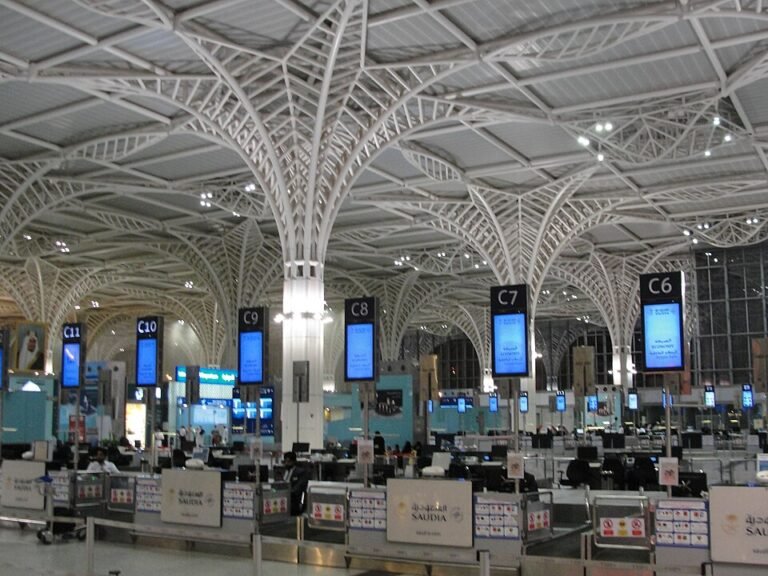
Prince Mohammad Bin Abdulaziz International Airport, Madinah
Additional items worth carrying
A printed or saved copy of your Nusuk platform booking confirmation, if your trip was arranged through Nusuk, since this can help clarify your itinerary if asked.
Contact details for your tour operator or accommodation, in case you need to explain your onward travel plans.
A note of any medication you are carrying, particularly for prescription items, along with a doctor’s letter if the medication could otherwise raise questions.
Emergency contact information for someone travelling with you and someone back home.
What happens if documents are incomplete
Missing or incomplete documentation can lead to delays at immigration, additional questioning, or in more serious cases, being denied entry and required to return on the next available flight. This is disruptive and stressful, and it can also affect your onward transport arrangements, since a pre-booked airport transfer is timed around a normal immigration process, not an extended delay caused by a documentation issue.
The safest approach is to check every document against the official requirements at least a week before you travel, giving yourself time to resolve any gaps, such as an out-of-date vaccination certificate or a visa reference that does not match your booking.
Practical checklist before you fly
Passport valid for at least six months, with your visa confirmed and matching your travel dates.
Meningitis ACWY vaccination certificate dated at least ten days before arrival, plus yellow fever certification if it applies to your route.
Return or onward flight confirmation and proof of accommodation.
Any Hajj-specific permit documents, kept together and easily accessible.
A copy of your transfer booking confirmation, so you know exactly where to meet your driver once you clear the airport.
In summary
Immigration at Madinah airport moves smoothly for pilgrims who arrive with the right paperwork ready to hand. Beyond your passport and visa, the meningitis vaccination certificate is the item most likely to catch out an otherwise well-prepared traveller, so double check the ten-day timing well before you fly. Get the documents right, and the rest of your arrival, including your onward transfer, should go exactly to plan.
Booking a Madinah airport transfer around a delayed or rescheduled flight
Flight delays and last-minute schedule changes happen, and when they do, the practicalities of a pre-booked airport transfer can feel like an added worry on top of an already stressful travel day. If your flight into Madinah is delayed or rescheduled, understanding how a good transfer booking handles that change makes it much easier to travel with confidence.
Why flight changes matter more for pilgrims
Unlike a typical holiday transfer, an Umrah or Hajj journey often involves connecting onward plans, whether that is joining a group already checked into a hotel, timing arrival around a specific prayer, or simply wanting to reach the Haram as soon as possible after a long journey. A delay of even a few hours can throw off all of these plans if your transport is not set up to adapt.
Madinah airport terminal
How a well-run transfer service handles delays
Flight tracking
A properly organised transport provider tracks your actual flight number rather than working from the original booked time. This means that if your flight from the UK is delayed by two hours, your driver’s arrival at Madinah airport adjusts automatically, and you are not left calling around trying to explain the change or, worse, arriving to find no one there.
Grace periods and waiting time
Reputable providers build a grace period into airport pickups, recognising that immigration and baggage reclaim can take longer than expected even without a flight delay. Ask what this grace period covers before you book, and clarify whether additional waiting time beyond that is charged, and at what rate, so there are no surprises if your arrival takes longer than planned.
Rescheduled and cancelled flights
If your flight is rescheduled to a different day entirely, rather than simply delayed by a few hours, your transfer booking needs to move with it. This is where booking through a provider with clear, published rescheduling terms matters far more than choosing the cheapest option, since an unofficial or informal arrangement may not have any process for this at all.
What to do if your flight changes
Contact your transport provider as soon as you know about the delay or reschedule, even if you assume they will already know from flight tracking.
Have your new flight number and revised arrival time ready to share.
Ask for confirmation that the change has been logged, ideally in writing, whether that is an email, app notification or text message.
If the delay pushes your arrival into a very different time of day, such as from afternoon to late night, check whether this affects pricing or vehicle availability.
Keep a backup contact number for your provider in case your usual point of contact is unavailable.
Departures at London Heathrow Airport, a common starting point for UK pilgrims
Questions to ask before you book
Not every transfer provider handles delays the same way, so it is worth asking a few direct questions before you commit to a booking, particularly for a long-haul or connecting flight where delays are more likely.
Do you track flights automatically, or do I need to inform you of any changes myself?
How long will a driver wait at no extra cost after the scheduled landing time?
What happens if my flight is delayed overnight or rescheduled to the next day?
Is there a cancellation or amendment fee if my travel dates change?
How do I reach you if I land outside normal office hours?
Booking with connecting flights in mind
If your journey to Madinah involves a connection, whether through another Gulf hub or via Jeddah, build in extra buffer time when you book your transfer, since a missed or delayed connection is more likely on a multi-leg journey than a direct flight. Providers who ask for your full itinerary, not just your final arrival flight, are generally better placed to adjust smoothly if an earlier leg runs late.
It is also worth avoiding transfers booked around very tight connection windows wherever possible. A comfortable buffer between your connecting flight landing and your final flight into Madinah reduces the chances of a cascading delay affecting your transfer booking at all.
In summary
Flight delays and reschedules are a normal part of long-distance travel, and a well-organised Madinah airport transfer should absorb them without adding stress to your journey. Choose a provider that tracks your flight automatically, offers a fair grace period, and has a clear process for rescheduled travel, and let them know about any change as soon as you can so your pickup can adjust with you rather than against you.
Comparing pickup wait times: Madinah airport versus Jeddah airport
Pilgrims planning a multi-city Umrah trip often ask the same practical question: which airport is quicker to clear, Madinah or Jeddah? Both serve huge numbers of pilgrims every year, but the pickup experience at each can feel quite different depending on the time of year, the time of day and how your flight fits into the wider pattern of arrivals. This guide compares typical pickup wait times at the two airports and explains what actually drives the difference.
Two very different airports
Prince Mohammad Bin Abdulaziz International Airport in Madinah is a purpose-built pilgrim gateway, smaller than Jeddah and largely focused on Umrah and Hajj traffic plus a modest number of domestic and regional routes. King Abdulaziz International Airport in Jeddah is a much larger hub, handling international, domestic and Hajj Terminal traffic together, with several terminals operating side by side. That difference in scale is the starting point for understanding why pickup waits can vary so much between the two.
Jeddah airport terminal
Typical pickup wait times at Madinah airport
Outside the busiest weeks of the year, pickup at Madinah airport tends to be relatively quick. The terminal is compact, immigration and baggage reclaim are usually straightforward to move through, and the pickup zone sits close to the arrivals exit. Many pilgrims report clearing the airport and reaching their driver within thirty to forty five minutes of landing on a quieter day.
That said, Madinah’s small footprint can work against it during genuinely busy periods, such as the last ten days of Ramadan or the weeks either side of Hajj. When several wide-body aircraft land close together, the single, more compact terminal can feel busier proportionally than Jeddah’s larger, more distributed layout, and waits can stretch out accordingly.
Typical pickup wait times at Jeddah airport
Jeddah’s scale cuts both ways. On one hand, the airport is built to handle very high passenger volumes, with the Hajj Terminal specifically designed for large seasonal surges. On the other hand, Jeddah serves as an entry point for a much wider mix of travellers, including international transit passengers, business travellers and domestic connections, which means immigration and customs can be busier as a baseline, even outside peak pilgrimage periods.
Pickup waits at Jeddah are commonly in the region of forty five minutes to over an hour once you account for the walk from the gate to immigration, baggage reclaim and the walk or shuttle out to the pickup zone, which can be a longer walk than at Madinah simply because of the terminal’s size. During Hajj season specifically, arrivals through the dedicated Hajj Terminal follow different, purpose-built processing designed to manage very large group volumes, which can move efficiently for organised groups but adds time for independent travellers navigating alongside them.
King Abdulaziz International Airport, Jeddah, Terminal 1
What actually drives the difference
Time of year: Both airports slow down significantly during Ramadan and Hajj, but the pattern of the slowdown differs, with Madinah more affected by the last ten nights of Ramadan and Jeddah more affected by the weeks around Hajj itself.
Time of day: Evening arrivals at both airports, particularly clusters of flights landing within an hour of each other, tend to produce the longest queues.
Flight mix: Jeddah’s broader mix of international and domestic traffic means immigration desks are shared across more passenger types, whereas Madinah’s queues are almost entirely pilgrims, which can make processing more predictable even if it is not always faster.
Terminal layout: Jeddah’s larger terminals mean more walking between gate, immigration, baggage and pickup, which adds time even when queues themselves move quickly.
What this means for your transfer booking
Because both airports can vary considerably depending on when you travel, it is worth building a buffer into your transfer plans rather than assuming a fixed wait time. A reliable transport provider will track your flight and adjust the driver’s arrival accordingly, so you are not paying for a driver sitting idle, and you are not left waiting once you clear the terminal.
If your itinerary includes both airports, for example flying into Jeddah and out through Madinah, or vice versa, it can help to plan the more relaxed leg of the trip around whichever airport tends to be busier at the time you are travelling, so you are not rushing an onward journey immediately after a long wait to clear immigration.
Practical tips for a smoother pickup at either airport
Share your flight number with your transport provider so pickup timing can adjust automatically to any delay.
Agree a clear meeting point in advance, particularly at Jeddah where the pickup areas can be spread across a wider area.
Keep your phone charged and available so your driver can reach you if plans change on the day.
Avoid scheduling anything time-sensitive immediately after landing during peak periods at either airport.
In summary
Madinah airport is generally quicker to clear on an ordinary day thanks to its smaller, more focused layout, while Jeddah’s scale means longer average waits but a system built to absorb very large seasonal surges. Neither airport is consistently faster once you factor in time of year and time of day, so the safest approach is to book a transfer that tracks your flight and plans around realistic waits rather than best-case assumptions.
What changes at Madinah airport during the last ten days of Ramadan
The last ten days of Ramadan are the busiest single stretch of the Umrah calendar, and nowhere feels that more than Prince Mohammad Bin Abdulaziz International Airport in Madinah. Pilgrims travelling to catch Laylat al-Qadr, itikaf and the final Taraweeh prayers of the month arrive in far greater numbers than usual, and the airport experience changes noticeably as a result. Knowing what to expect helps you plan a realistic transfer and avoid the frustration of a delay you had not budgeted for.
Why the last ten nights draw such a surge
Many Muslims specifically time their Umrah trip to catch the odd nights of the last ten days of Ramadan, when Laylat al-Qadr is believed to fall. Airlines add extra services and larger aircraft on routes from the UK and other major Umrah source markets during this window, and Madinah becomes a preferred entry point for pilgrims who want to spend the final stretch of Ramadan at Masjid an-Nabawi before moving on to Makkah. The result is a sustained surge in arrivals that peaks around the 20th night of Ramadan and stays elevated through to Eid.
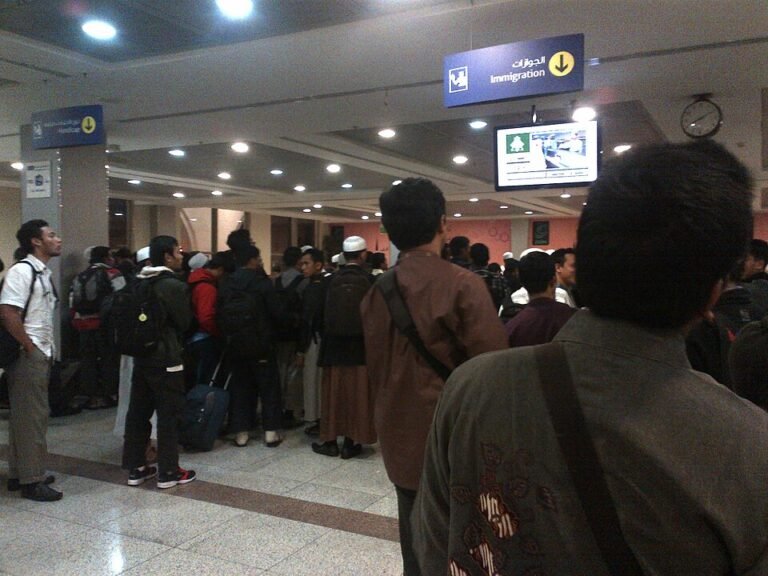
Immigration queue at Madinah airport
What actually changes at the airport
Arrivals halls and immigration
Immigration queues lengthen considerably during this period, simply because more flights are landing closer together and each one is fuller than average. Saudi authorities typically add extra desks and staff to manage the flow, but even with that support, pilgrims should expect immigration processing to take longer than it would outside Ramadan, particularly for flights arriving in the evening once Taraweeh has finished and demand for onward transport peaks.
Baggage reclaim
With more aircraft cycling through in a shorter window, baggage reclaim can be slower and busier than usual. Carousels fill up quickly and porters are in high demand, so it is worth keeping hold of any valuables and essential items in hand luggage rather than relying on a swift bag collection.
Kerbside pickup areas
The pickup and drop-off zones outside the terminal see the most visible change. Traffic marshals manage a steady stream of taxis, private transfers and group buses, and during peak hours it can take longer for a driver to reach the designated meeting point once you have cleared the terminal. This is where a pre-booked transfer with a clear meeting instruction makes the most difference, since drivers familiar with the airport’s Ramadan patterns can plan around the busiest slots.
How this affects your transfer booking
During the last ten days of Ramadan, transport demand in Madinah does not just come from the airport. Hotels near Masjid an-Nabawi are full, taxis are in heavy demand for the short hop to and from the mosque for each prayer, and drivers themselves are often balancing longer working hours around their own fast and prayer commitments. All of this means that booking your airport transfer well in advance, rather than expecting to arrange one on arrival, is far more important during this window than at quieter times of year.
It also helps to build extra time into your plans. A transfer that might take twenty five minutes from the airport to a central hotel outside Ramadan could reasonably take forty five minutes to an hour once you add immigration queues, baggage collection and busier roads into the mix, especially if your flight lands in the hours immediately before or after iftar.
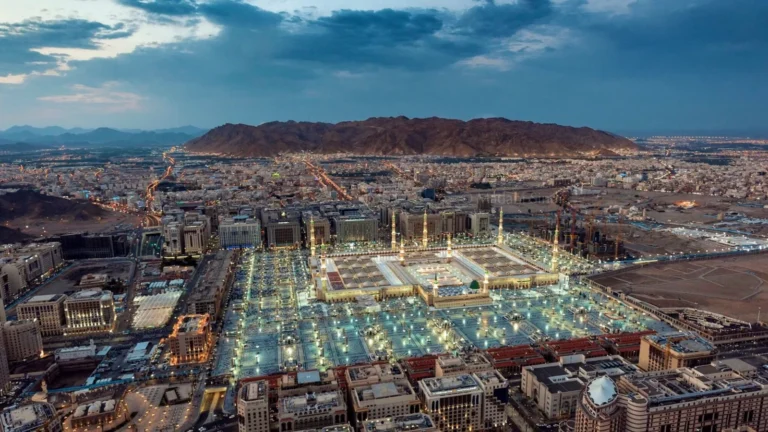
Masjid an-Nabawi at night during Ramadan
Timing your arrival around prayer and iftar
If you have any flexibility over your arrival time, it is worth thinking about how it lines up with the day’s prayer and fasting schedule. Flights that land in the couple of hours before Maghrib can mean a rushed transfer as everyone, including your driver, is racing to break their fast on time. Arrivals a little later in the evening, after iftar, often move a touch more smoothly, though the roads around the Haram remain busy well into the night as pilgrims head out for Taraweeh and, on the odd nights, for extended night prayers.
Daytime arrivals during the last ten days tend to be calmer at the airport itself, though the heat and the fasting hours mean drivers and pilgrims alike are often more comfortable avoiding unnecessary waiting around in the open.
Practical tips for travelling during this period
Book your Madinah airport transfer well ahead of travel, ideally as soon as your flight is confirmed, since demand for reliable transport peaks alongside flight arrivals.
Share your flight number with your transport provider so they can track any delays, which are more common during this busy period.
Keep essentials, including any medication and a change of clothes, in hand luggage in case baggage reclaim takes longer than expected.
Allow extra time between landing and any plans that depend on a fixed schedule, such as joining family already in Madinah for a specific prayer.
Stay hydrated and comfortable while waiting, since queues and pickup waits can be longer than usual even with good planning.
In summary
The last ten days of Ramadan bring a genuine, predictable surge to Madinah airport, from fuller immigration queues to busier pickup zones. None of this is unmanageable, but it does call for a bit more planning than a quieter month. Book your transfer early, share your flight details, and build a little extra time into your schedule so the excitement of arriving for the final stretch of Ramadan is not overshadowed by an avoidable wait.
Best hotels near Masjid an-Nabawi and how distance affects your transfer choice
Choosing where to stay in Madinah is one of the first decisions a pilgrim makes, and it is also one that quietly shapes almost everything else about the trip. The distance between your hotel and Masjid an-Nabawi affects how you get to prayer, how you manage luggage, how your airport transfer is timed, and how much walking is realistic for elderly relatives or young children. This guide looks at how hotel distance from the Haram works in practice, and how it should inform the transport you book, both for the airport transfer and for getting around once you have checked in.
Why distance from the Haram matters more than the hotel star rating
Madinah’s hotel market is organised in rings around Masjid an-Nabawi. The closest properties sit within a few hundred metres of the mosque’s outer courtyard, close enough to walk to any of the five daily prayers in a couple of minutes. Beyond that first ring, hotels spread out along King Fahd Road, Quba Road and the surrounding districts, with some budget-friendly options a fifteen to twenty minute walk or a short taxi ride away.
A five-star hotel eight hundred metres from the Haram and a modest three-star hotel two hundred metres away will give very different pilgrimage experiences. The closer option means less time spent commuting to prayer, less exposure to midday heat, and far simpler logistics for anyone travelling with mobility limitations. The trade-off is usually price, since rooms with a direct view of the mosque’s courtyard or gates command a significant premium, especially during Ramadan and the Hajj season.
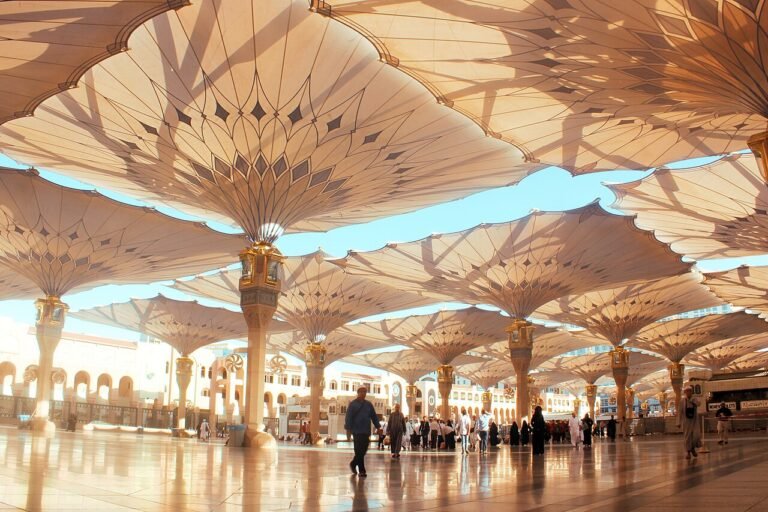
Madinah city plaza near the hotel district
How hotel distance changes your airport transfer
Prince Mohammad Bin Abdulaziz International Airport sits around fifteen to twenty kilometres from central Madinah, and the drive time to the hotel district is fairly consistent regardless of which ring you are staying in, usually somewhere between twenty and forty minutes depending on traffic and time of day. Where distance from the Haram starts to matter is in the final stretch of the journey.
Many of the streets immediately surrounding Masjid an-Nabawi are pedestrianised or subject to vehicle restrictions, particularly during busy prayer times and throughout Ramadan. A driver dropping you at a hotel directly on the plaza may need to set down at a designated point some distance from the entrance, with porters or luggage trolleys covering the last stretch. Hotels further out, by contrast, often have a car park or a direct kerbside drop-off, which can actually make the final few minutes of a long journey more comfortable if you are travelling with young children, heavy luggage or someone who struggles to walk far after a long flight.
When you book your Madinah airport transfer, it is worth telling your driver or transport provider exactly which hotel you are staying at and, ideally, sharing the hotel’s own guidance on vehicle access, since some central-ring hotels publish specific drop-off instructions for exactly this reason.
Matching your hotel choice to your itinerary
First-time pilgrims and families
If this is your first trip and you are travelling with children, elderly parents or anyone who needs frequent breaks, a hotel within easy walking distance of the Haram usually justifies the extra cost. It removes an entire layer of daily logistics: no need to plan taxi pickups around each of the five prayers, no risk of missing Isha because traffic backed up on the walk back, and a much shorter distance to carry a tired child back to the room.
Longer stays and budget-conscious trips
Pilgrims staying a week or more, or those travelling on a tighter budget, often do well with a hotel a short taxi ride from the mosque. The savings on accommodation can be considerable, and a few short taxi journeys a day are a manageable trade-off, provided you plan for them rather than assume you can simply walk when needed, particularly in the heat of the day.
Practical distance bands to know
Within 300 metres: Walking to every prayer is realistic for most pilgrims, including many with limited mobility if the route is flat and well lit. Expect the highest room rates.
300 to 800 metres: A comfortable ten to fifteen minute walk for most adults, though this becomes harder in the midday heat or for anyone who tires quickly. A good middle ground for many families.
800 metres to 2 kilometres: Walking is possible but not always practical for every prayer. Short taxi journeys become part of the daily routine, so it helps to have a transport plan rather than relying on hailing a taxi on the spot, especially at night.
Beyond 2 kilometres: Taxi or shuttle transport becomes necessary for most pilgrims for most journeys to the Haram. This band often includes some of the better value accommodation in Madinah.
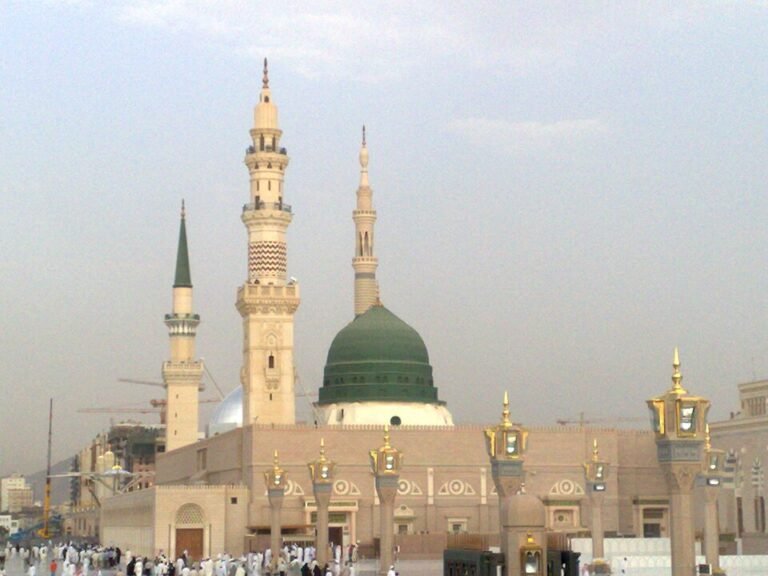
The Green Dome of Masjid an-Nabawi, a landmark for orientation
Questions worth asking before you book a hotel
Booking platforms do not always give an honest sense of walking distance, since a hotel listed as “near Masjid an-Nabawi” can still be a genuine twenty-minute walk away once you account for the route pedestrians actually have to take, rather than a straight line on a map. Before booking, it is worth checking a few things.
Search the hotel name alongside Masjid an-Nabawi on a mapping app and check the walking route, not just the straight-line distance.
Look at recent reviews for comments about the actual walk, particularly from pilgrims travelling with children or elderly relatives.
Ask whether the hotel has a shuttle service to the Haram during peak periods, which some mid-range and budget hotels offer even when not directly on the plaza.
Confirm whether your transport provider can drop off directly at the hotel entrance or whether a short walk from a designated point will be needed.
Planning your transfer around your chosen hotel
Once you have settled on a hotel, share the exact address and, where possible, the hotel’s name in Arabic with whoever is arranging your Madinah airport transfer. This avoids confusion at busy drop-off points where several similarly named hotels sit close together. If your hotel is inside a pedestrianised zone, ask in advance about the nearest practical drop-off point and roughly how far that is from reception, so you are not caught out with heavy luggage after a long flight.
Booking your transfer in advance, rather than arranging transport on arrival, also gives you the chance to build in a little extra time if your hotel sits in a busier part of the city, particularly around Friday prayers or during Ramadan evenings when the roads closest to the mosque see the heaviest restrictions.
In summary
Hotel distance from Masjid an-Nabawi is not just a comfort question, it shapes your daily routine, your transport needs and how manageable the trip feels for everyone in your group. Weigh the walking distance honestly against who you are travelling with, budget for taxi journeys if you choose a hotel further out, and make sure your airport transfer provider knows exactly where you are headed so the last leg of your journey is as smooth as the flight itself.
Prince Mohammad Bin Abdulaziz Airport: Arrivals, Customs and Transport Timing
Landing at Prince Mohammad Bin Abdulaziz Airport in Madinah is, for many pilgrims, the calmer of the two Saudi airport arrivals compared with Jeddah, but it still involves a genuine sequence of steps between touchdown and stepping outside to your transport. Understanding what that sequence actually looks like, and roughly how long each stage takes, is what lets you book your pickup time with confidence instead of guessing.
Reviewed planning guidance. Airport processing times vary by flight schedule, time of day and season. Use the ranges below as planning guidance and confirm your own airline’s expected arrival experience where possible.
The arrivals process at Madinah Airport, step by step
Prince Mohammad Bin Abdulaziz Airport handles a high proportion of pilgrim traffic, particularly on routes serving UK and European carriers, and its arrivals process follows a broadly standard international sequence, even though the exact experience on the day depends on how many flights land close together.
Disembarkation and the walk to immigration
After leaving the aircraft, pilgrims typically follow signage through to the immigration hall. On a quiet flight, this can take only a few minutes; when several wide-body flights land within a short window of each other, which happens often during peak Umrah and Hajj periods, the walk and any initial queuing before the immigration desks can add noticeably more time.
Immigration and passport control
At immigration, passports are checked and, depending on current procedures, biometric details such as fingerprints or a photograph may be taken. First-time pilgrims should have their passport, and if applicable their Nusuk platform confirmation or Hajj/Umrah visa documentation, easily accessible rather than buried in checked luggage or a bottom pocket, since this is the step most likely to take longer than expected if paperwork is not immediately to hand.
Baggage reclaim
Once through immigration, pilgrims proceed to the baggage hall to collect checked luggage. Timing here depends heavily on how quickly bags are unloaded from the specific aircraft and how busy the carousel area is, which is largely outside any individual pilgrim’s control.
Customs and the exit to arrivals
A customs check follows baggage reclaim, after which pilgrims exit into the public arrivals area where pre-booked transport, hotel shuttles and taxi ranks are located. For pilgrims who have arranged a private transfer in advance, this exit point is where a driver will typically be waiting with a name board or similar identification.
Realistic timing from landing to the kerb
Because so much of this process depends on how many flights land in the same window, giving a single fixed number for “landing to kerb” would be misleading. What is more useful is understanding the two ends of the range.
On a quieter flight or off-peak period
Outside the busiest weeks of the Islamic calendar, and on flights that land without several other wide-bodies close behind them, pilgrims can reasonably expect to move from disembarkation through immigration, baggage reclaim and customs in well under an hour in many cases, sometimes considerably less if the airport is quiet.
During peak Umrah and Hajj periods
During Ramadan, the weeks around Hajj, and other high-volume travel periods, multiple long-haul and regional flights can land within a short window of one another, which stacks up queues at immigration and increases pressure on baggage handling. Pilgrims arriving during these periods should build in noticeably more contingency time than they would for a quiet midweek arrival.
How arrivals timing should shape your transport booking
The practical reason to understand this process is that it directly affects when you should ask your transport provider to have a driver in place, and, just as importantly, what happens if your actual time through the terminal runs longer than planned.
Booking a pickup window, not a single minute
Rather than asking a driver to arrive at your exact scheduled landing time, it is worth booking transport with an understanding that landing time and kerb time are two different things. A sensible pickup window accounts for the realistic range above, so your driver is not left waiting needlessly on a quick clearance, or, worse, arriving late relative to when you actually emerge.
Flight tracking and grace periods
A transport provider that tracks your actual flight, rather than only the scheduled time on your original booking, is better placed to adjust for both early and delayed landings. Ask whether your provider offers a grace period built into pickups from Madinah Airport specifically, since this is exactly the kind of detail that turns a stressful first hour into a manageable one, particularly after a long overnight flight from the UK.
What to do if you clear the terminal faster or slower than expected
If you find yourself through the terminal well ahead of your booked pickup time, most providers can be contacted to bring the pickup forward, though this is not guaranteed and depends on driver availability. If you are delayed by a longer immigration queue than usual, a provider with live flight tracking should already be adjusting, but it is still worth keeping your booking confirmation and provider contact details easily accessible so you can reach them directly if needed.
Practical tips for a smoother arrival
Keep documents together
Passport, boarding pass stub, and any printed or digital Nusuk confirmation kept in one accessible place, rather than spread across hand luggage, noticeably speeds up the immigration step.
Expect variability, not a fixed number
Because arrivals timing depends on how many other flights land around yours, treat any timing estimate, including the ranges above, as planning guidance rather than a guarantee, and build in a reasonable buffer, particularly if you are travelling during a known busy period.
Confirm your pickup point in advance
Ask your transport provider exactly where in the arrivals area they will be waiting before you fly, so you are not searching for a driver in an unfamiliar terminal after a long journey.
Special assistance and first-time pilgrim considerations
Wheelchair and mobility assistance
Passengers who need wheelchair or mobility assistance through the terminal should request this from their airline in advance, since it affects how you move through immigration and baggage reclaim rather than something arranged after landing. Airport staff generally coordinate this assistance from the aircraft door through to the arrivals area, but the request needs to be logged with your airline before you fly for it to be waiting when you land. If you have arranged a private transfer, it is worth telling your transport provider as well, so the driver knows to expect a longer or different exit route from the terminal.
Travelling with elderly relatives
Older pilgrims often move through the arrivals sequence more slowly than a younger traveller would, particularly the walk between the gate and immigration on a large terminal. If you are travelling with elderly parents or grandparents, building extra time into your own expectations, on top of the general ranges above, is a sensible default rather than something to work out on the day.
First-time pilgrims and unfamiliar paperwork
For pilgrims arriving in Saudi Arabia for the first time, the immigration step can feel more uncertain simply because the process is unfamiliar. Reading through what to expect before you fly, and keeping your Nusuk confirmation and any other required documentation together and easily reachable, removes most of the uncertainty that otherwise makes this step feel slower than it needs to be.
How Madinah’s arrival experience differs from Jeddah
Many UK pilgrims fly into Jeddah first and travel onward to Madinah later in their trip, which means the Madinah arrival, when it happens, is often the second Saudi airport experience of the journey rather than the first. Madinah’s terminal generally handles a smaller volume of simultaneous long-haul arrivals than Jeddah, which is part of why many pilgrims describe it as the calmer of the two. That said, during Ramadan and the weeks around Hajj, Madinah still sees substantial pilgrim traffic, and the peak period guidance above applies just as much here as it would at any other major Saudi airport.
Prince Mohammad Bin Abdulaziz International Airport in Madinah is a much smaller, calmer building than Jeddah’s sprawling multi-terminal complex, and most pilgrims find the walk from aircraft to arrivals hall considerably quicker. That does not mean the meeting-point details take care of themselves. Knowing exactly where a pre-booked driver waits, and what to do if you cannot see them straight away, still makes the difference between a smooth pickup and a stressful few minutes standing in a busy hall with luggage.
Reviewed planning guidance. Details can change; use the linked official sources and get a live quote for current pricing and availability.
What the airport itself looks like on arrival
Prince Mohammad Bin Abdulaziz International Airport is a single passenger terminal building, which already simplifies things compared with Jeddah’s separate Terminal 1, North Terminal and Hajj and Umrah complex. After disembarking, you will pass through passport control, collect checked luggage from the baggage claim area, and clear customs into a single public arrivals hall, where pre-booked drivers typically wait with a name board rather than needing to be directed to one of several possible pickup zones.
Because there is only one arrivals hall to coordinate around, communication with your driver is generally simpler here than at a larger, multi-terminal airport. The main variables that still matter are how busy the hall is when you land and exactly where within it your driver has been told to wait.
Where drivers typically wait
Licensed transport providers picking up at Madinah airport generally position themselves just outside the arrivals exit doors, in the area where taxi and private hire pickups are permitted to wait, holding a name board or booking reference visible to arriving passengers. Exact positioning can shift slightly depending on current airport traffic management and any temporary restrictions in place, particularly during very busy periods, so confirm your specific meeting point with your provider at the time of booking rather than assuming it will be identical to a previous trip.
What to look for as you exit
As you come through the arrivals doors, look for a name board with your name or booking reference clearly displayed, rather than scanning for a particular uniform or vehicle colour, since these can vary between drivers and providers. If you booked through a company rather than an individual driver, your booking confirmation should tell you what name or reference will appear on the board.
What to do if you cannot see your driver straight away
If you exit the arrivals hall and cannot immediately spot your name board, the first step is simply to move a short distance further into the waiting area and look again, since the hall can be busy with other arriving passengers and greeting parties, and a driver may be positioned slightly further along than expected. If you still cannot locate them after a couple of minutes, call or message the number on your booking confirmation. A driver working regularly at this airport will usually already be aware of any minor delay in your immigration or baggage processing, since a reputable provider tracks your flight in real time.
Keep your phone charged and accessible before you land specifically for this reason. A short phone call resolves the vast majority of momentary mix-ups far faster than continuing to search the hall on your own.
Landing at unusual hours
Madinah airport handles a mix of daytime and overnight arrivals depending on airline schedules, and a pickup at 2am works differently to one at 2pm largely because the arrivals hall itself is quieter, which if anything makes it easier to spot your driver, but you should still confirm at booking time that your provider operates pickups at your specific arrival hour, particularly if you are flying on an unusual routing or a late-notice ticket change.
If you are travelling with family or a group
Groups landing together should agree in advance who holds the booking confirmation and phone number for the driver, rather than assuming everyone in the party has this to hand, so that if the group becomes separated moving through the terminal, at least one person can make contact and coordinate where everyone should gather.
Frequently asked questions
Where exactly will my driver be waiting at Madinah airport?
Typically just outside the arrivals exit doors in the designated pickup area, holding a name board or booking reference. Confirm the specific meeting point with your provider at booking time, since airport traffic arrangements can shift.
What should I look for when I come through arrivals?
Look for a name board matching your name or booking reference rather than a particular vehicle or uniform colour, since these vary between providers.
What if I cannot find my driver when I land?
Move a short distance further into the waiting area and look again, since the hall can be busy. If you still cannot see them after a couple of minutes, call the number on your booking confirmation directly.
Does it matter if my flight lands very early in the morning or late at night?
Confirm at booking time that your provider covers pickups at your specific arrival hour. The arrivals hall itself is generally quieter outside daytime hours, which can make spotting your driver easier.
Transport, airport, visa and visitor arrangements can change. These official sources are provided so you can check the current position for your journey. Checked 2026-07-25.
Hajj & Umrah Taxi Cab Co gives every driver your flight number and a clear meeting point at Madinah airport before you land, and a direct phone number on your booking confirmation in case you need it. Book ahead and your pickup is arranged before your wheels touch down.
Starting Your Trip in Madinah: How a Madinah-First Itinerary Changes Your Transport Plan
Most Umrah itineraries out of the UK are built around flying into Jeddah first, then travelling on to Makkah before finishing in Madinah. A growing number of pilgrims do the opposite: fly into Prince Mohammad Bin Abdulaziz International Airport in Madinah, begin their pilgrimage there, and only reach Makkah later in the trip. If that is your plan, several of the assumptions built into a typical Jeddah-first itinerary do not apply, and it is worth understanding what changes before you book your transport.
Reviewed planning guidance. Details can change; use the linked official sources and get a live quote for current pricing and availability.
Why some pilgrims choose to start in Madinah
Reasons for a Madinah-first itinerary vary. Some airlines simply route more conveniently or cheaply into Madinah from certain UK departure points. Some pilgrims prefer to visit the Prophet’s Mosque and complete their Ziyarah in Madinah while they are fresh at the start of the trip, rather than at the end when tiredness has built up. Others are following guidance from a particular scholar or group leader about the order in which to approach the two holy cities. Whatever the reason, the practical transport planning is genuinely different from a Jeddah-first trip, not just the same plan in reverse.
Your first transport booking is Madinah airport to your hotel, not Jeddah to Makkah
The most obvious change is that your first pickup is at Prince Mohammad Bin Abdulaziz International Airport rather than King Abdulaziz International Airport in Jeddah. This matters because the two airports are different in scale and layout, Madinah’s airport is considerably smaller and more straightforward to navigate than Jeddah’s multi-terminal complex, and the drive time and route into central Madinah is a different journey entirely from the Jeddah-to-Makkah corridor most Umrah transport guides are written around.
Book this leg with the same care as any other
Because a Madinah-first arrival is less commonly discussed than the Jeddah route, some first-time pilgrims underprepare for it, assuming any airport transfer is basically the same. Book it with your flight number, arrival time and passenger count in exactly the same way you would for a Jeddah pickup, and confirm the meeting point in advance.
Ihram timing works differently on a Madinah-first trip
For pilgrims flying into Jeddah, entering the state of Ihram is typically planned around crossing the miqat boundary on the way to Makkah, sometimes at the airport itself depending on your flight and connections. On a Madinah-first itinerary, you generally complete your time in Madinah first, without needing to be in Ihram for that portion of the trip, and only enter Ihram later when you leave Madinah for Makkah, usually at Dhul Hulayfah, the miqat point associated with departures from Madinah. This changes what you need to plan for on your outbound transport leg into Madinah itself, since it is not the moment you need to be dressed and ready in the way a Jeddah arrival can be.
The Madinah to Makkah leg becomes your intercity journey
Instead of the well documented Jeddah-to-Makkah route, your main intercity transport booking on a Madinah-first trip is the journey from Madinah to Makkah, whether by private taxi, by the Haramain High Speed Rail, or a combination of both if your hotel is not close to a station at either end. This leg also needs to account for your Ihram and miqat timing, since your provider should understand that you will be dressed for Ihram and may need a stop at or near Dhul Hulayfah before continuing to Makkah, which is a different logistical requirement to a standard point-to-point transfer.
Tell your provider the direction of travel
When you book Makkah-Madinah intercity transport, be specific that you are travelling from Madinah to Makkah as the outbound leg of a Madinah-first trip, including the miqat stop, rather than assuming a generic intercity booking covers this automatically. A provider used to both directions of travel will plan the stop correctly once they know your itinerary shape.
Your final departure may also be from a different airport than you expect
Some Madinah-first pilgrims fly home from Jeddah after finishing in Makkah, rather than flying back out through Madinah, particularly if their return flight schedule or airline routing works out that way. Others complete a loop back to Madinah for departure. Either is workable, but it means your transport plan has three, not two, distinct legs to book: the Madinah arrival, the Madinah-to-Makkah intercity leg, and a final transfer to whichever airport your return flight actually departs from. Confirm your full itinerary, including your return flight’s departure airport, before you book any individual leg, so nothing is planned in isolation.
Frequently asked questions
Is a Madinah-first Umrah itinerary common?
It is less common than a Jeddah-first itinerary but not unusual, and is often driven by flight routing, personal preference, or guidance from a group leader. The transport planning differs enough from the standard Jeddah route that it is worth planning specifically rather than assuming the same approach applies.
Do I need to be in Ihram when I land in Madinah?
No. On a Madinah-first itinerary you typically complete your time in Madinah before entering Ihram, which is usually done later at Dhul Hulayfah when you leave for Makkah. Confirm the correct approach for your specific circumstances with a knowledgeable source before you travel.
Should I book my Madinah-to-Makkah transport differently on this itinerary?
Tell your provider you are travelling outbound from Madinah to Makkah as part of a Madinah-first trip, including any miqat stop you need, so they can plan the journey correctly rather than treating it as a generic transfer.
What if my return flight leaves from a different airport to where I arrived?
This is common on Madinah-first itineraries. Confirm your full flight itinerary, including the departure airport for your return leg, before booking any individual transport segment, so your final transfer is planned against the right airport.
Transport, airport, visa and visitor arrangements can change. These official sources are provided so you can check the current position for your journey. Checked 2026-07-25.
Hajj & Umrah Taxi Cab Co plans your transport around your full itinerary, whether you are flying into Jeddah or Madinah first, including the miqat stop your outbound intercity leg needs. Tell us your itinerary shape when you book and we will plan every leg correctly from the start.