

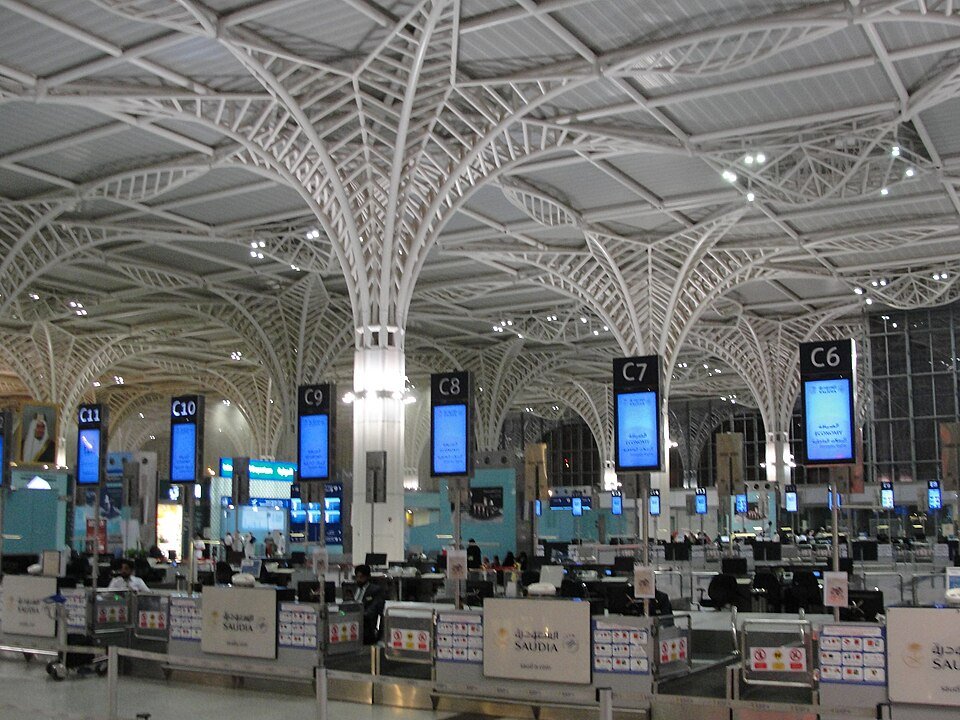
Landing at Prince Mohammad Bin Abdulaziz Airport in Madinah is, for many pilgrims, the calmer of the two Saudi airport arrivals compared with Jeddah, but it still involves a genuine sequence of steps between touchdown and stepping outside to your transport. Understanding what that sequence actually looks like, and roughly how long each stage takes, is what lets you book your pickup time with confidence instead of guessing.
Reviewed planning guidance. Airport processing times vary by flight schedule, time of day and season. Use the ranges below as planning guidance and confirm your own airline’s expected arrival experience where possible.
The arrivals process at Madinah Airport, step by step
Prince Mohammad Bin Abdulaziz Airport handles a high proportion of pilgrim traffic, particularly on routes serving UK and European carriers, and its arrivals process follows a broadly standard international sequence, even though the exact experience on the day depends on how many flights land close together.
Disembarkation and the walk to immigration
After leaving the aircraft, pilgrims typically follow signage through to the immigration hall. On a quiet flight, this can take only a few minutes; when several wide-body flights land within a short window of each other, which happens often during peak Umrah and Hajj periods, the walk and any initial queuing before the immigration desks can add noticeably more time.
Immigration and passport control
At immigration, passports are checked and, depending on current procedures, biometric details such as fingerprints or a photograph may be taken. First-time pilgrims should have their passport, and if applicable their Nusuk platform confirmation or Hajj/Umrah visa documentation, easily accessible rather than buried in checked luggage or a bottom pocket, since this is the step most likely to take longer than expected if paperwork is not immediately to hand.

Baggage reclaim
Once through immigration, pilgrims proceed to the baggage hall to collect checked luggage. Timing here depends heavily on how quickly bags are unloaded from the specific aircraft and how busy the carousel area is, which is largely outside any individual pilgrim’s control.
Customs and the exit to arrivals
A customs check follows baggage reclaim, after which pilgrims exit into the public arrivals area where pre-booked transport, hotel shuttles and taxi ranks are located. For pilgrims who have arranged a private transfer in advance, this exit point is where a driver will typically be waiting with a name board or similar identification.
Realistic timing from landing to the kerb
Because so much of this process depends on how many flights land in the same window, giving a single fixed number for “landing to kerb” would be misleading. What is more useful is understanding the two ends of the range.
On a quieter flight or off-peak period
Outside the busiest weeks of the Islamic calendar, and on flights that land without several other wide-bodies close behind them, pilgrims can reasonably expect to move from disembarkation through immigration, baggage reclaim and customs in well under an hour in many cases, sometimes considerably less if the airport is quiet.
During peak Umrah and Hajj periods
During Ramadan, the weeks around Hajj, and other high-volume travel periods, multiple long-haul and regional flights can land within a short window of one another, which stacks up queues at immigration and increases pressure on baggage handling. Pilgrims arriving during these periods should build in noticeably more contingency time than they would for a quiet midweek arrival.
How arrivals timing should shape your transport booking
The practical reason to understand this process is that it directly affects when you should ask your transport provider to have a driver in place, and, just as importantly, what happens if your actual time through the terminal runs longer than planned.
Booking a pickup window, not a single minute
Rather than asking a driver to arrive at your exact scheduled landing time, it is worth booking transport with an understanding that landing time and kerb time are two different things. A sensible pickup window accounts for the realistic range above, so your driver is not left waiting needlessly on a quick clearance, or, worse, arriving late relative to when you actually emerge.
Flight tracking and grace periods
A transport provider that tracks your actual flight, rather than only the scheduled time on your original booking, is better placed to adjust for both early and delayed landings. Ask whether your provider offers a grace period built into pickups from Madinah Airport specifically, since this is exactly the kind of detail that turns a stressful first hour into a manageable one, particularly after a long overnight flight from the UK.

What to do if you clear the terminal faster or slower than expected
If you find yourself through the terminal well ahead of your booked pickup time, most providers can be contacted to bring the pickup forward, though this is not guaranteed and depends on driver availability. If you are delayed by a longer immigration queue than usual, a provider with live flight tracking should already be adjusting, but it is still worth keeping your booking confirmation and provider contact details easily accessible so you can reach them directly if needed.
Practical tips for a smoother arrival
Keep documents together
Passport, boarding pass stub, and any printed or digital Nusuk confirmation kept in one accessible place, rather than spread across hand luggage, noticeably speeds up the immigration step.
Expect variability, not a fixed number
Because arrivals timing depends on how many other flights land around yours, treat any timing estimate, including the ranges above, as planning guidance rather than a guarantee, and build in a reasonable buffer, particularly if you are travelling during a known busy period.
Confirm your pickup point in advance
Ask your transport provider exactly where in the arrivals area they will be waiting before you fly, so you are not searching for a driver in an unfamiliar terminal after a long journey.
Special assistance and first-time pilgrim considerations
Wheelchair and mobility assistance
Passengers who need wheelchair or mobility assistance through the terminal should request this from their airline in advance, since it affects how you move through immigration and baggage reclaim rather than something arranged after landing. Airport staff generally coordinate this assistance from the aircraft door through to the arrivals area, but the request needs to be logged with your airline before you fly for it to be waiting when you land. If you have arranged a private transfer, it is worth telling your transport provider as well, so the driver knows to expect a longer or different exit route from the terminal.
Travelling with elderly relatives
Older pilgrims often move through the arrivals sequence more slowly than a younger traveller would, particularly the walk between the gate and immigration on a large terminal. If you are travelling with elderly parents or grandparents, building extra time into your own expectations, on top of the general ranges above, is a sensible default rather than something to work out on the day.
First-time pilgrims and unfamiliar paperwork
For pilgrims arriving in Saudi Arabia for the first time, the immigration step can feel more uncertain simply because the process is unfamiliar. Reading through what to expect before you fly, and keeping your Nusuk confirmation and any other required documentation together and easily reachable, removes most of the uncertainty that otherwise makes this step feel slower than it needs to be.
How Madinah’s arrival experience differs from Jeddah
Many UK pilgrims fly into Jeddah first and travel onward to Madinah later in their trip, which means the Madinah arrival, when it happens, is often the second Saudi airport experience of the journey rather than the first. Madinah’s terminal generally handles a smaller volume of simultaneous long-haul arrivals than Jeddah, which is part of why many pilgrims describe it as the calmer of the two. That said, during Ramadan and the weeks around Hajj, Madinah still sees substantial pilgrim traffic, and the peak period guidance above applies just as much here as it would at any other major Saudi airport.
Related guides
- Prince Mohammad Bin Abdulaziz Airport: A Complete Transfer Guide
- Where to Meet Your Driver at Madinah Airport
- Prince Mohammad Bin Abdulaziz Airport to Madinah: Your Transport Guide